GEMS-1
(Last updated 1/4/09)
In February of 2004 I was accidently
(re)introduced to the world of colored gemstones. Since then my
curiosity about these shiny baubles has morphed into an unhealthy
passion for these marvelous minerals that now encompasses collecting
as well as learning everything I can about them. And although
I started using collecting as a way to discover what the gemstones
I only knew from pictures really looked like, the inventory of
duplicate stones I soon developed
has led to another "hobby," the production of simple
facteted stone jewelry as a way for me to share my new passion
with family and friends, and perhaps increase their tolerance
of me until this latest obsession of mine runs its course (if
ever). I have even more recently expanded my interests to include
stones that are usually available only in translucent or opaque
form (and thus are cut as cabochons), with a concomitant foray
into wire wrapped jewelry as well.
Altogether about 70 of the 4000+
known minerals can yield colored gemstones, although only about
20 of these are commonly encountered in jewelry. Pictured below
are examples of gemstones from my collection, as well as some
of the simple jewelry I've made. Given my background as a chemist,
the emphasis in the descriptions of the photos I've chosen (which
don't really do any of the gems justice) is on the chemical and
physical properties of the minerals from which these gemstones
are derived, and in particular what produces their color.
Diamonds, probably the best known
of all gemstones, are a crystalline form of the single element
carbon. Said to have been first discovered in a river bed in India
in about 500 BC, they were found again in the rivers of Brazil
in 1725, and later in other alluvial ("secondary") deposits
in Borneo and South Africa (1866).
Up until the late 19th century,
diamonds were genuinely rare, and world production of gem quality
stones amounted to only a few pounds per year. But in 1870, huge
diamond "pipes" were discovered near the Orange River
in South Africa. These were primary deposits, "chimneys"
of kimberlite rock that marked craters where volcanic activity
had brought diamonds near to the surface from up to 300 miles
below - where they had been formed under tremendous heat and pressure.
Suddenly modern mining methods could be used, and diamonds were
NOT rare.
In fact, modern production of gem
quality diamonds now exceeds 30 million carats per year (one ct
= 1/5 of a gram; 141.75 ct = one ounce; so annual production equals
more than 13,200 lbs!!), plus over 100 million carats more that
are used for industrial purposes; and there are almost a billion
carats of gem quality diamonds already in the hands of the public.
Why, then, is there the perception
that diamonds are so rare and valuable? The answer is the De Beers
cartel and its advertising campaign, which has not only created
new markets around the world for its product, but has convinced
the public that "diamonds are forever" and should never
be sold. [This story is chronicled in a marvelous book by Edward
Jay Epstein, "The Diamond Invention"; see excerpts at
http://edwardjayepstein.com/diamond/prologue.htm]
Usually thought of as colorless
(another legacy of De Beers), diamonds are, in fact, found in
many colors, especially pinks, oranges, yellows, greens, blues,
browns (with gimmicky marketing names like cognac and champagne),
and even grays and blacks. But unlike colorless diamonds, "fancy"
(colored) diamonds are truly rare, with perhaps one found for
every 10,000 colorless diamonds, and with almost all under one
carat in size. Such diamonds are thus truly valuable - pink diamonds
have sold at auction for over $1 million per carat [even one point
(or 0.01ct) pinks for up to $5000/ct]; and a 0.90ct vivid green
recently sold for over $600,000 - even though they are unknown
to the majority of the public (eg, the Hope is probably the most
famous diamond in the world, but few people realize that it's
a blue with a color so deep that it's nearly opaque).
The Argyle diamond mine in Australia
(the world's largest), which started production in 1985, has changed
this situation somewhat because Argyle produces more colored diamonds
than all previous sources combined; and almost from its beginning,
Argyle decided to market its own diamonds rather than join the
De Beers cartel. As a result, colored diamonds started to come
onto the market at reasonable prices and in significant numbers,
with a corresponding increase in the public's appreciation of
- and demand for - these beautiful and rare gems.
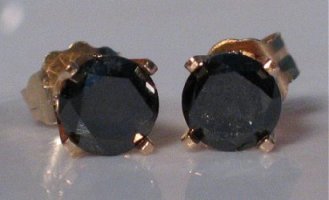
Pictured below are a pair of 5mm
(in diameter) round "diamond cut" black diamonds, each
weighing about 0.4ct, set as studs in 14 karat yellow gold (14kt
=> 14 of 24 parts, or 58.3%, pure gold mixed with 10 parts
of an alloy, usually copper and silver). Natural black diamonds
(but not black carbonados, which are aggregates of tiny crystalline
diamonds formed over half a billion years ago by meteor impacts
on the earth's surface) are colored by tiny, plate-like inclusions
of graphite (confirmation that all diamonds near the earth's surface
are slowly converting to this more stable form of carbon now that
they are under normal temperatures and pressures). However, the
blacks pictured below were produced by high intensity neutron
bombardment of faceted, low quality diamonds, a new technique
recently developed to meet growing market demand.
Rubies and sapphires are among the
most ancient, historically important, and best known of the colored
gemstones. Both, in fact, are the same mineral - corundum, or
aluminum oxide, Al2O3, which in pure crystalline form is colorless.
However, when ca 1% chromium (Cr) is introduced into the structure
of a corundum crystal, replacing some of the Al atoms, the result
is a red ruby.
Most commercial rubies come from
one of five geographical areas in the world - Burma (Myanmar),
Madagascar, Tanzania/the Serengeti, Thailand, or Vietnam. Because
of slight variations in chromium content and the presence of other
trace metals, the reds observed in rubies from different locations
range from a purplish or bluish red to an orange or yellowish
red, often with brownish undertones. The most prized color is
displayed by certain Burmese rubies, especially some from the
Mogok Valley - an almost spectrally pure, highly fluorescent (due
to the absence of iron) red with a faint undertone of blue - often
described as "pigeon's blood" red - that remains constant
in color and shows inner fire even in low light.
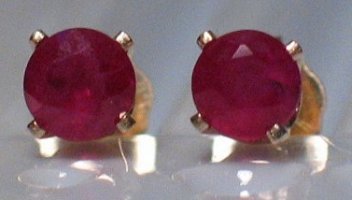
A pair of 4mm round Burmese rubies,
each ca 0.3ct, set as studs in 14kt yg...
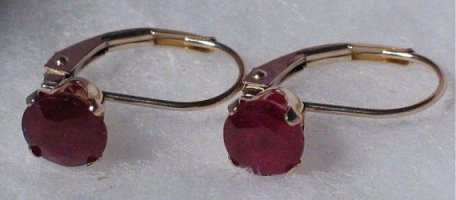
 ...and a pair of Madagascar rubies,
6mm rounds, each ca 1.2ct, set in leverback style 14kt yg earrings.
...and a pair of Madagascar rubies,
6mm rounds, each ca 1.2ct, set in leverback style 14kt yg earrings.
 Most people think of sapphires as
blue but, in fact, corundum comes in almost every color besides
ruby red, and any corundum gemstone that isn't a ruby is a sapphire.
Most commonly sapphires come in hues of blue, green, gold, yellow,
orange, purple, and pink; and colors other than pink (which is
due to a lower but still significant chromium content) are produced
primarily by trace amounts (usually less than 0.01%) of iron (Fe),
titanium (Ti), vanadium (V), and gallium that become dominant
in the absence of Cr. For example, in blue sapphire, it is charge
transfer absorption effects between neighboring pairs of Fe2+
and Ti4+ in the corundum lattice that generate the blue color.
The most famous blue sapphires come
from a deposit in the mountains of Kashmir (discovered in 1880,
long since mined out) and from Burma; such stones are close to
a pure spectral blue. Fine sapphires are also found in Sri Lanka
(Ceylon), Thailand, Madagascar, Cambodia, Australia, Montana (the
Yogo Gulch; sapphires from other parts of the state are generally
"fancy," ie, non-blue, stones), and more recently, Tanzania
and Brazil.
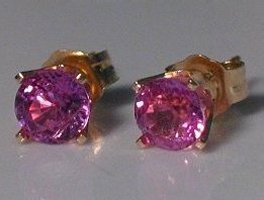
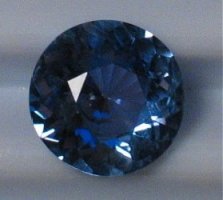
Pictured below are a pair of 0.6ct
round diamond cut pink sapphire studs in 14kt yg (left), and a
2.2ct, 9mm round Ceylon blue sapphire (right)...
Most people think of sapphires as
blue but, in fact, corundum comes in almost every color besides
ruby red, and any corundum gemstone that isn't a ruby is a sapphire.
Most commonly sapphires come in hues of blue, green, gold, yellow,
orange, purple, and pink; and colors other than pink (which is
due to a lower but still significant chromium content) are produced
primarily by trace amounts (usually less than 0.01%) of iron (Fe),
titanium (Ti), vanadium (V), and gallium that become dominant
in the absence of Cr. For example, in blue sapphire, it is charge
transfer absorption effects between neighboring pairs of Fe2+
and Ti4+ in the corundum lattice that generate the blue color.
The most famous blue sapphires come
from a deposit in the mountains of Kashmir (discovered in 1880,
long since mined out) and from Burma; such stones are close to
a pure spectral blue. Fine sapphires are also found in Sri Lanka
(Ceylon), Thailand, Madagascar, Cambodia, Australia, Montana (the
Yogo Gulch; sapphires from other parts of the state are generally
"fancy," ie, non-blue, stones), and more recently, Tanzania
and Brazil.
Pictured below are a pair of 0.6ct
round diamond cut pink sapphire studs in 14kt yg (left), and a
2.2ct, 9mm round Ceylon blue sapphire (right)...
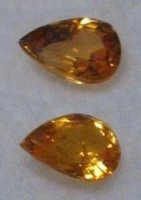
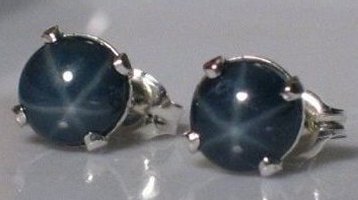
 ...a pair of 0.5ct pear shaped golden
sapphires (left), and a pair of 1.2ct 6mm round cabochon cut blue
star sapphires (right), set in sterling silver (s/s; 92.5% pure
silver alloyed with 7.5% copper, a standard supposedly set by
King Edward I of England in 1300, unchanged since then).
...a pair of 0.5ct pear shaped golden
sapphires (left), and a pair of 1.2ct 6mm round cabochon cut blue
star sapphires (right), set in sterling silver (s/s; 92.5% pure
silver alloyed with 7.5% copper, a standard supposedly set by
King Edward I of England in 1300, unchanged since then).
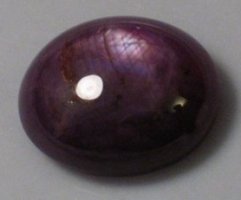
 The picture below provides a glimpse
into an 8+ct star ruby from Sri Lanka; the fine needles of rutile
(TiO2) included within are clearly visible. It's the refraction
of light by such needles that causes the star effect, or "asterism,"
in this stone, and also in the blue star sapphires above.
The picture below provides a glimpse
into an 8+ct star ruby from Sri Lanka; the fine needles of rutile
(TiO2) included within are clearly visible. It's the refraction
of light by such needles that causes the star effect, or "asterism,"
in this stone, and also in the blue star sapphires above.
The mineral beryl - beryllium aluminum
silicate, Be3Al2(SiO3)6 - is the principal source of beryllium
in the earth's crust and, as such, is economically very important
(beryllium is used in areas as diverse as spark plugs, aircraft
alloys, and the nuclear industry). Colorless in pure form (called
goshenite; used to make spectacles in ancient times), it is also
the source of some of the best known and most important colored
gemstones when various impurities are introduced into its complex
zeolite-like crystal lattice: green emeralds when Cr or/and V
are present; blue to greenish-blue aquamarine ("sea blue")
in the presence of ferrous iron, Fe2+, and golden beryl with ferric
iron, Fe3+ (and intermediate colors when mixtures of both iron
oxidation states are present); yellow beryl to greenish-yellow
heliodor with Fe3+ and uranium; violet-pink to peach morganite
with manganese, Mn2+; and raspberry-colored red beryl (bixbite;
found only in the Wah Wah mountains of Utah, and among the rarest
of gemstones in the world) when higher concentrations of Mn2+
(as well as Fe and Cr) are present.
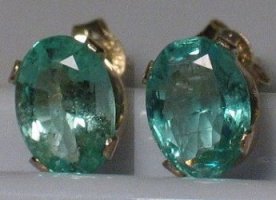
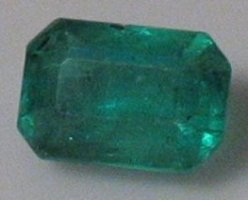
A pair of 0.8ct 7x5mm oval Columbian
emeralds (colored by Cr) in 14kt yg (left), and an 0.4ct 6x4mm
emerald cut Zambian emerald (right; colored by V) - examples of
the best known member of the beryl family
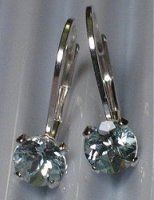
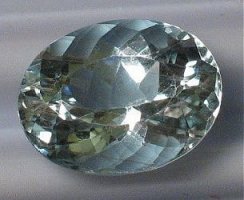
 A pair of 0.5ct 5mm round aquamarines
set in s/s leverbacks (left) and an unheated (as indicated by
the greenish undertones) 4.1ct 12x10mm modified Portuguese cut
oval aquamarine (right)
A pair of 0.5ct 5mm round aquamarines
set in s/s leverbacks (left) and an unheated (as indicated by
the greenish undertones) 4.1ct 12x10mm modified Portuguese cut
oval aquamarine (right)
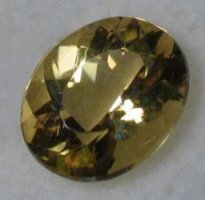
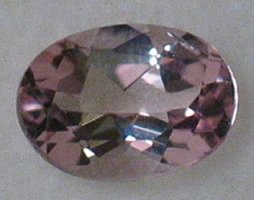
 Among the lesser known members of
the family, a 2.3ct 10x8mm oval golden beryl (left) and an 0.75ct
7x5mm oval morganite (right)
Among the lesser known members of
the family, a 2.3ct 10x8mm oval golden beryl (left) and an 0.75ct
7x5mm oval morganite (right)
The garnet family of minerals is
extremely complex, consisting of at least 16 different silicates
of the general formula A3B2(SiO4)3 - where A represents the divalent
metals calcium, iron, magnesium, or manganese and B represents
trivalent metals such as aluminum, chromium, iron, or manganese
(and in the rarer garnets, vanadium, titanium, zirconium, or silicon)
- that share the same crystal structure. Six of these minerals
(the pyralspite group, where A=Fe, Mg, or Mn and B=Al, and the
ugrandite group, where A=Ca and B=Fe, Al or Cr), together with
several binary and a few tertiary combinations, provide most gemstone
quality garnets. Although commonly thought of as a red stone (the
carbuncle of antiquity), natural garnets come in every color except
blue (and examples of even these have recently been found), thanks
to absorption produced by a wide variety of impurities such as
iron, magnesium, chromium, vanadium, and titanium that can be
incorporated into the garnet lattice. And although it is a relatively
common mineral, some garnets, eg, tsavorite and especially demantoid,
are among the rarest gemstones in the world.
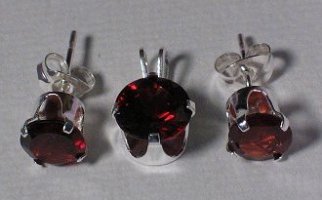
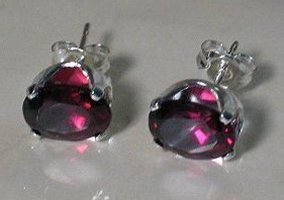
A pair of 0.5ct 5mm round red garnets
(left; probably almandine, with A=Fe and B=Al) in s/s studs, with
a matching 2ct 8mm round stone set as a pendant, also in s/s;
and a pair of 1.1ct 8x6mm oval raspberry colored rhodolites (right;
a 2:1 mixture of pyrope, where A=Mg and B=Al, and almandine) in
s/s
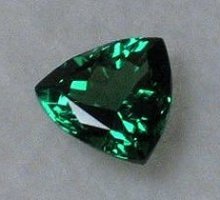
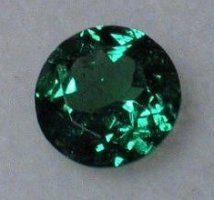
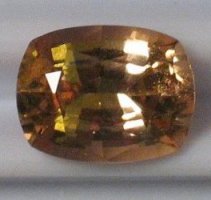
 Tsavorite is a grossular garnet,
with A=Ca and B=Al; the color is due to the presence of traces
of vanadium in this otherwise colorless gemstone. A very rare
gem, and one of my favorites, the total output of tsavorite is
less than 1000 carats per year, with almost all stones under 1
carat. An intensely colored (deeply saturated) 0.5ct 5x5mm trillion
cut tsavorite (left) and an 0.75ct 6mm round diamond cut tsavorite
(center). The 3.5ct elongated cushion cut hessonite (right) is
another grossular garnet; its color is caused by iron impurities
Tsavorite is a grossular garnet,
with A=Ca and B=Al; the color is due to the presence of traces
of vanadium in this otherwise colorless gemstone. A very rare
gem, and one of my favorites, the total output of tsavorite is
less than 1000 carats per year, with almost all stones under 1
carat. An intensely colored (deeply saturated) 0.5ct 5x5mm trillion
cut tsavorite (left) and an 0.75ct 6mm round diamond cut tsavorite
(center). The 3.5ct elongated cushion cut hessonite (right) is
another grossular garnet; its color is caused by iron impurities
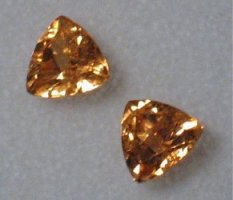
 A pair of 1.0ct 6x6mm trillion (triangular
shaped) mandarin colored spessartine garnets (A=Mn, B=Al) from
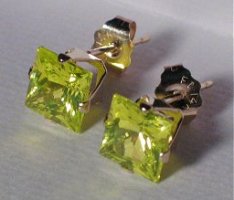
Namibia (left), and a pair of 1.6ct 6mm square princess cut canary
YAGs (right), set in 14kt yg studs. The man-made garnet YAG (yttrium
aluminum garnet), with A=Y, B=Al, was initially produced as a
colorless crystal in the late '50s; a neodymium-doped version
was used in laser research in the 1960s
A pair of 1.0ct 6x6mm trillion (triangular
shaped) mandarin colored spessartine garnets (A=Mn, B=Al) from
Namibia (left), and a pair of 1.6ct 6mm square princess cut canary
YAGs (right), set in 14kt yg studs. The man-made garnet YAG (yttrium
aluminum garnet), with A=Y, B=Al, was initially produced as a
colorless crystal in the late '50s; a neodymium-doped version
was used in laser research in the 1960s
 Go to Gems-2 | Go to Gems-3 | Wire-wrapped Jewelry | Return
to Home Page
Go to Gems-2 | Go to Gems-3 | Wire-wrapped Jewelry | Return
to Home Page