WIRE-WRAPPED JEWELRY
(Last updated 12/16/08)
On this page I've tried to illustrate
the various techniques and styles of wrapping, and also the wide
variety of stones, that I've used to make wire-wrapped jewelry.
However, the stones (and styles of wrapping) shown here only scratch
the surface. There are literally thousands of types of stones
that can be used, many of which I've collected for future use;
I'll be adding pix of some of my favorites in the near future
(see Available
Cabochons). I should also add that to me the stone's the
star, with the wire wrap a way to present - and hopefully enhance
- its beauty, not overshadow it.
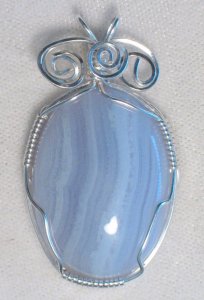
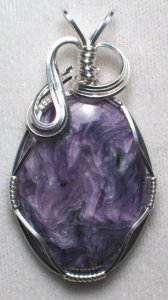
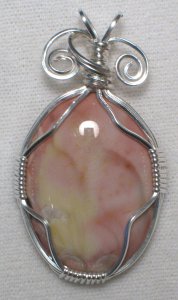
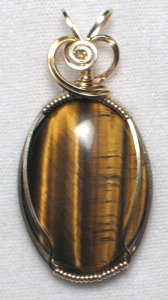
Shown below are pendants containing
the most common type of cabochon, an oval, in this case 30x22mm
in size (except for the stone at left, which is a 40x30), all
symmetrically wrapped but finished in a variety of styles. [Relative
sizes of pendants can be estimated by comparison with the bail
(the wire "vee" at the top), which I try to make the
same size in most cases - usually large enough to accomodate a
3mm omega (or cord) necklace.] The stones, from left to right,
are Namibian blue lace agate, Russian charoite, Willow Creek (Idaho)
jasper, and South African tiger's eye, respectively (all are types
of microcrystalline quartz, or chalcedony, except for the charoite,
which is a rare mineral so far found only in the Murun Mountains
of Yakutia). All are wrapped in sterling silver wire (s/s, 92.5%
pure silver by weight), except for the tiger's eye, which is wrapped
in 14kt gold-filled wire (GF, a 14kt gold sleeve, 20% of the total
by weight, "shrink-wrapped" onto a wire core that work
hardens to provide stiffness so the setting will maintain its
shape).
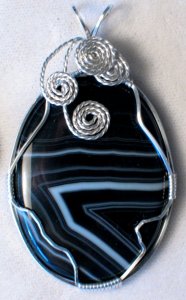
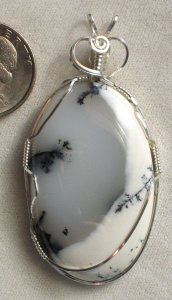
 The pendants below contain similar
oval cabochons that are wrapped in ways that still hold the cabs
securely in place, but also (hopefully) compliment the asymmetric
patterns in the stones themselves. On the left is an onyx (an
agate, or type of translucent quartz, that's black and usually
striped with white), and on the right an interesting combination
of milky and dendritic quartz (milky's color comes from microscopic
liquid inclusions, while dendritic gets its name from its black
tree-like inclusions - which are really fissure-filled stains
of manganese dioxide).
The pendants below contain similar
oval cabochons that are wrapped in ways that still hold the cabs
securely in place, but also (hopefully) compliment the asymmetric
patterns in the stones themselves. On the left is an onyx (an
agate, or type of translucent quartz, that's black and usually
striped with white), and on the right an interesting combination
of milky and dendritic quartz (milky's color comes from microscopic
liquid inclusions, while dendritic gets its name from its black
tree-like inclusions - which are really fissure-filled stains
of manganese dioxide).
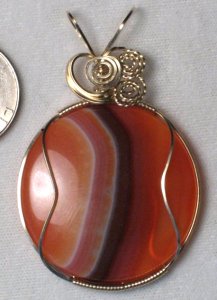
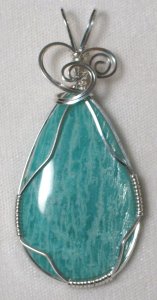
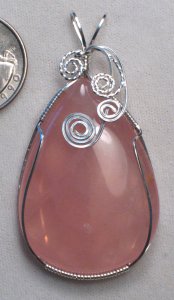
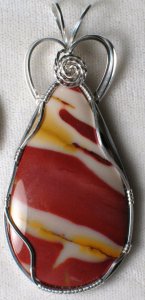
 The pendants below contain several
other standard shapes of cabochons: on the far left a large round
sardonyx (a variant of onyx in which the colored bands are formed
primarily from different shades of reddish sard), symmetrically
wrapped but asymmetrically finished (in 14kt GF); and (from left
center to right) pear shaped cabs of Russian amazonite (a layered
type of microcline feldspar, probably from the area of Miass in
the Ilmen Mountains southwest of Chehabinsk), Brazilian rose quartz
(unlike in the crystalline form, in this "massive" form
the color was recently found to be caused by microfibrous inclusions
of a still unidentified mineral), and Mookaite (the popular name
of a fossilized siltstone formed from billions of tiny silicified
shells of sea organisms known as radiolarians, found mainly in
an outcrop along Mooka Creek - on Mooka Station, a sheep farm
- on the west side of the Kennedy Range in Western Australia!).
The pendants below contain several
other standard shapes of cabochons: on the far left a large round
sardonyx (a variant of onyx in which the colored bands are formed
primarily from different shades of reddish sard), symmetrically
wrapped but asymmetrically finished (in 14kt GF); and (from left
center to right) pear shaped cabs of Russian amazonite (a layered
type of microcline feldspar, probably from the area of Miass in
the Ilmen Mountains southwest of Chehabinsk), Brazilian rose quartz
(unlike in the crystalline form, in this "massive" form
the color was recently found to be caused by microfibrous inclusions
of a still unidentified mineral), and Mookaite (the popular name
of a fossilized siltstone formed from billions of tiny silicified
shells of sea organisms known as radiolarians, found mainly in
an outcrop along Mooka Creek - on Mooka Station, a sheep farm
- on the west side of the Kennedy Range in Western Australia!).
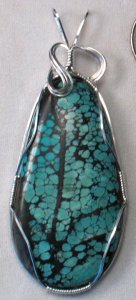
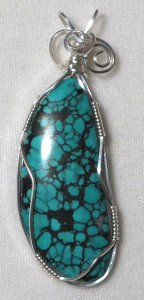
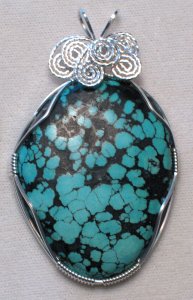
 Irregularly shaped cabs can also
be wrapped, as illustrated with the delicately spider-webbed Chinese
turquoise stones shown below.
Irregularly shaped cabs can also
be wrapped, as illustrated with the delicately spider-webbed Chinese
turquoise stones shown below.
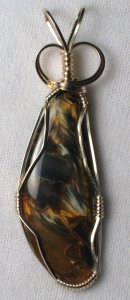
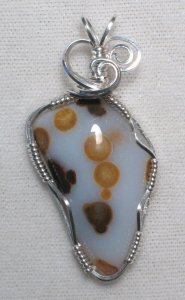
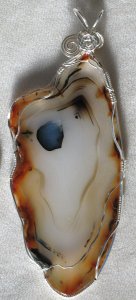
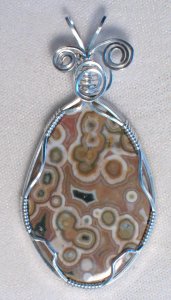
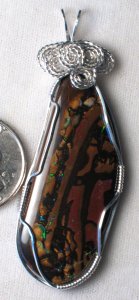
 In fact, most cabs cut from unusual
or exotic materials are irregular in shape and non-standard in
size. Shown below (from left to right) are a pietersite (related
to tiger's eye) from Namibia, a relatively small polka dot jasper
from Oregon, a huge slab of Montana agate, a thick orbicular ocean
jasper from the northwest coast of Madagascar, and a large Koroit
boulder opal from Queensland, Australia.
In fact, most cabs cut from unusual
or exotic materials are irregular in shape and non-standard in
size. Shown below (from left to right) are a pietersite (related
to tiger's eye) from Namibia, a relatively small polka dot jasper
from Oregon, a huge slab of Montana agate, a thick orbicular ocean
jasper from the northwest coast of Madagascar, and a large Koroit
boulder opal from Queensland, Australia.
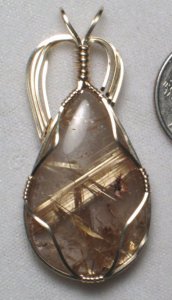
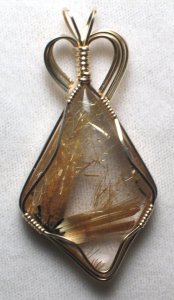
 To further illustrate, the pendants
below all contain rutilated quartz cabs of various sizes and shapes.
Even though these pieces are composed mainly of the common mineral
quartz (with needles of the mineral rutile encased within), because
of the way they are formed in nature, no two rutilated cabs are
ever alike, and pieces with attractive needle patterns, in quartz
that is crystal clear, are very rare. (I usually wrap these cabs
in 14kt, but think they also look attractive in s/s, as on the
far left.)
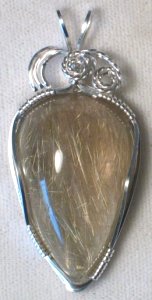
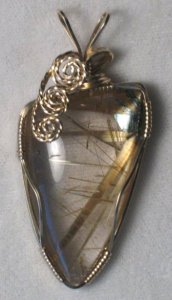
To further illustrate, the pendants
below all contain rutilated quartz cabs of various sizes and shapes.
Even though these pieces are composed mainly of the common mineral
quartz (with needles of the mineral rutile encased within), because
of the way they are formed in nature, no two rutilated cabs are
ever alike, and pieces with attractive needle patterns, in quartz
that is crystal clear, are very rare. (I usually wrap these cabs
in 14kt, but think they also look attractive in s/s, as on the
far left.)
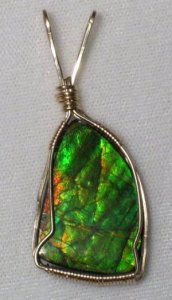
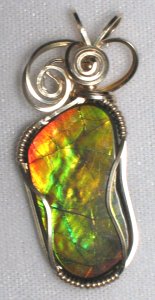
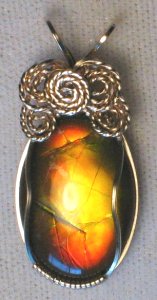
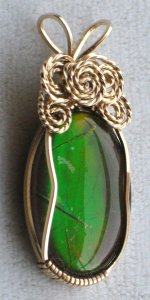
 One of my favorite exotic materials
is ammolite, the fossilized shell of a sea creature called the
ammonite. An ancestor of the squid that resembled the modern day
chambered nautilis, ammonites became extinct about 65 million
years ago. While ammonites were very common in all the oceans
of the world and fossils of many different species are widely
distributed, gem quality ammolite is found in only one place -
along the banks of the St. Mary's River in southern Alberta, Canada
(once under the Bearpaw Sea)! The two pendants on the left contain
ammolite doublets - thin layers of fossilized shell on a natural
hard stone backing. The two pictures on the right are of the same
pendant, which contains an 18x13mm ammolite triplet (a doublet
with a clear cap of spinel to protect it) that shows an amazing
chromatic shift - a dramatic color change that depends on the
angle from which it is viewed. In my opinion, ammolites are the
stars of the optical "-escence" world (eg, opalescence,
adularescence, etc), surpassing all but the very best of opals
in their color play.
One of my favorite exotic materials
is ammolite, the fossilized shell of a sea creature called the
ammonite. An ancestor of the squid that resembled the modern day
chambered nautilis, ammonites became extinct about 65 million
years ago. While ammonites were very common in all the oceans
of the world and fossils of many different species are widely
distributed, gem quality ammolite is found in only one place -
along the banks of the St. Mary's River in southern Alberta, Canada
(once under the Bearpaw Sea)! The two pendants on the left contain
ammolite doublets - thin layers of fossilized shell on a natural
hard stone backing. The two pictures on the right are of the same
pendant, which contains an 18x13mm ammolite triplet (a doublet
with a clear cap of spinel to protect it) that shows an amazing
chromatic shift - a dramatic color change that depends on the
angle from which it is viewed. In my opinion, ammolites are the
stars of the optical "-escence" world (eg, opalescence,
adularescence, etc), surpassing all but the very best of opals
in their color play.
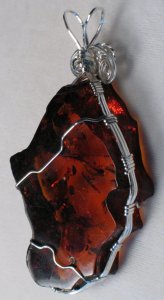
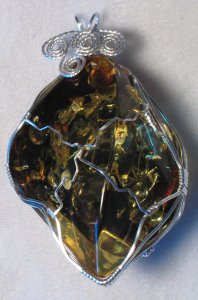
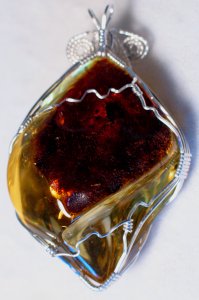
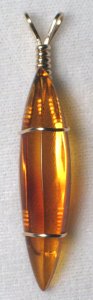
 Another favorite of mine is BALTIC
amber (there are over 300 different amber deposits scattered around
the world), one of the oldest gem materials used by man, and also
a fossil - formed in the case of Baltic from the sap of an ancient
pine tree containing succinic acid (possibly of the genus Pseudolarix,
recently found to still exist in the mountains of China) that
was buried about 40-50 million years ago. Because of amber's very
low density, very large pieces can be used for pendants, as in
most of the examples shown. While Baltic amber is normally thought
of as yellow (left) or honey to amber/brownish red (center) in
color, green varieties are also common (center right), and there
are even unique specimens of blue. More unusual (and much older)
are varieties of opaque yellow amber (often called butterscotch)
in which pale yellow or white streaks are distributed on a darker
yellow background (2nd row, center left), and opaque white varieties
called chalky (2nd row, center right). Most pieces also contain
air bubbles or other inclusions, eg, plant materials in the case
of greens or, most famously, bugs a la Jurassic Park (2nd row,
right).
Another favorite of mine is BALTIC
amber (there are over 300 different amber deposits scattered around
the world), one of the oldest gem materials used by man, and also
a fossil - formed in the case of Baltic from the sap of an ancient
pine tree containing succinic acid (possibly of the genus Pseudolarix,
recently found to still exist in the mountains of China) that
was buried about 40-50 million years ago. Because of amber's very
low density, very large pieces can be used for pendants, as in
most of the examples shown. While Baltic amber is normally thought
of as yellow (left) or honey to amber/brownish red (center) in
color, green varieties are also common (center right), and there
are even unique specimens of blue. More unusual (and much older)
are varieties of opaque yellow amber (often called butterscotch)
in which pale yellow or white streaks are distributed on a darker
yellow background (2nd row, center left), and opaque white varieties
called chalky (2nd row, center right). Most pieces also contain
air bubbles or other inclusions, eg, plant materials in the case
of greens or, most famously, bugs a la Jurassic Park (2nd row,
right).
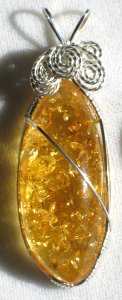
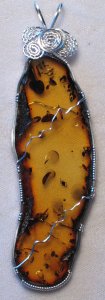
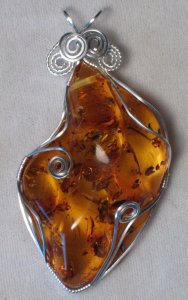
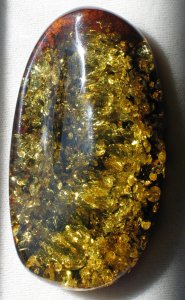
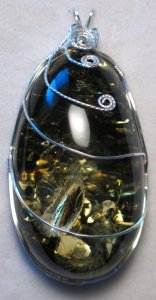
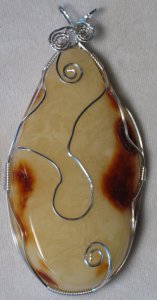
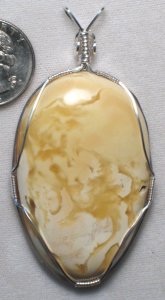
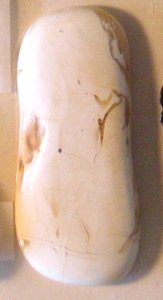
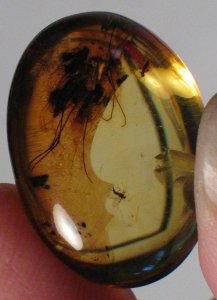 In addition, the unusual shapes
and thicknesses that are usually cut to make maximum use of this
fairly rare material require special and often unique wrapping
techniques. This is illustrated in the front and back views of
the very thick and extremely irregular pieces pictured below (left
and center left, center right and right, respectively).
In addition, the unusual shapes
and thicknesses that are usually cut to make maximum use of this
fairly rare material require special and often unique wrapping
techniques. This is illustrated in the front and back views of
the very thick and extremely irregular pieces pictured below (left
and center left, center right and right, respectively).
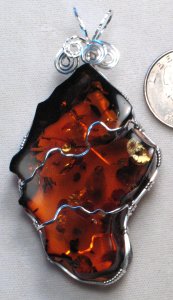
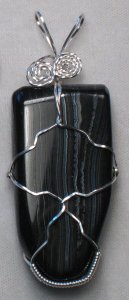
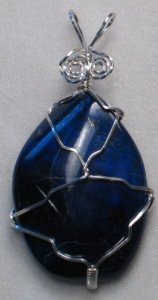
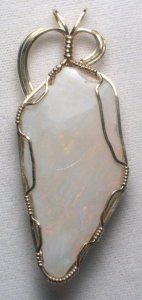
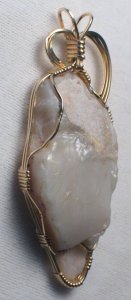
 In that regard, one of the unique
wrapping techniques that I've developed is what I call the "impossible"
setting (left): as in, "How did the stone get in there, given
that it doesn't bend?" Finally, special techniques and custom
wraps can be used to turn almost any stone into a pendant, as
illustrated with the very thick and irregularly shaped crocodilite
and lapis lazuli rocks (left center and center), and in the front
and back views (right center and right) of a very large piece
of opal rough (from Coober Pedy, Australia) that had been polished
on the front to show its opalescence, but otherwise left with
its very irregular natural shape.
In that regard, one of the unique
wrapping techniques that I've developed is what I call the "impossible"
setting (left): as in, "How did the stone get in there, given
that it doesn't bend?" Finally, special techniques and custom
wraps can be used to turn almost any stone into a pendant, as
illustrated with the very thick and irregularly shaped crocodilite
and lapis lazuli rocks (left center and center), and in the front
and back views (right center and right) of a very large piece
of opal rough (from Coober Pedy, Australia) that had been polished
on the front to show its opalescence, but otherwise left with
its very irregular natural shape.
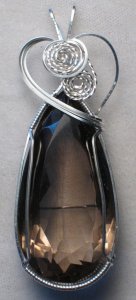
 Wire wrapping techniques can also
be used to set faceted stones, as shown (at left) with this large
(nearly 100 carats!) pear shaped smoky quartz (the trick is to
fashion a setting that extends below the culette/bottom of the
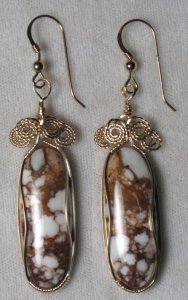
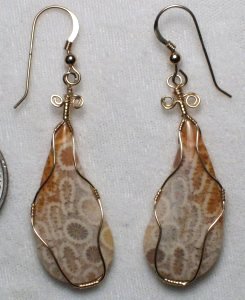
stone so the pendant will lie flat on the neck). And finally,
matching pairs of stones - like the elongated Wild Horse magnesite
cabochons or the mirror image cut, paisley-shaped Indonesian fossil
coral cabs can be symmetrically (center) or mirror image (right)
wrapped (in 14 kt gold, in these instances) to produce spectacular
dangle earrings.
Wire wrapping techniques can also
be used to set faceted stones, as shown (at left) with this large
(nearly 100 carats!) pear shaped smoky quartz (the trick is to
fashion a setting that extends below the culette/bottom of the
stone so the pendant will lie flat on the neck). And finally,
matching pairs of stones - like the elongated Wild Horse magnesite
cabochons or the mirror image cut, paisley-shaped Indonesian fossil
coral cabs can be symmetrically (center) or mirror image (right)
wrapped (in 14 kt gold, in these instances) to produce spectacular
dangle earrings.
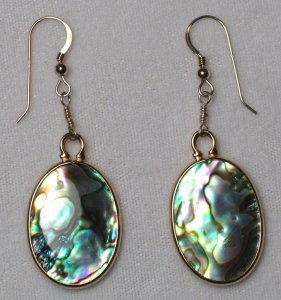
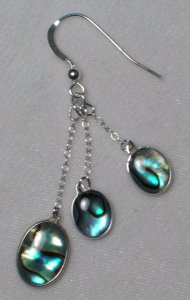
 For completeness, I've shown below
a simpler style of cabochon setting that I've also used to produce
earrings (and pendants); both examples make use of natural-colored
cab-cut shell from the Paua, the Maori word for three species
of the sea snail genus Haliotis, a relative of the abalone found
in the coastal waters of New Zealand.
For completeness, I've shown below
a simpler style of cabochon setting that I've also used to produce
earrings (and pendants); both examples make use of natural-colored
cab-cut shell from the Paua, the Maori word for three species
of the sea snail genus Haliotis, a relative of the abalone found
in the coastal waters of New Zealand.
 Go to Gems-1 | Go to Gems-2
| Go to
Gems-3 | Go
to Available Cabochons | Return to Home Page
Go to Gems-1 | Go to Gems-2
| Go to
Gems-3 | Go
to Available Cabochons | Return to Home Page